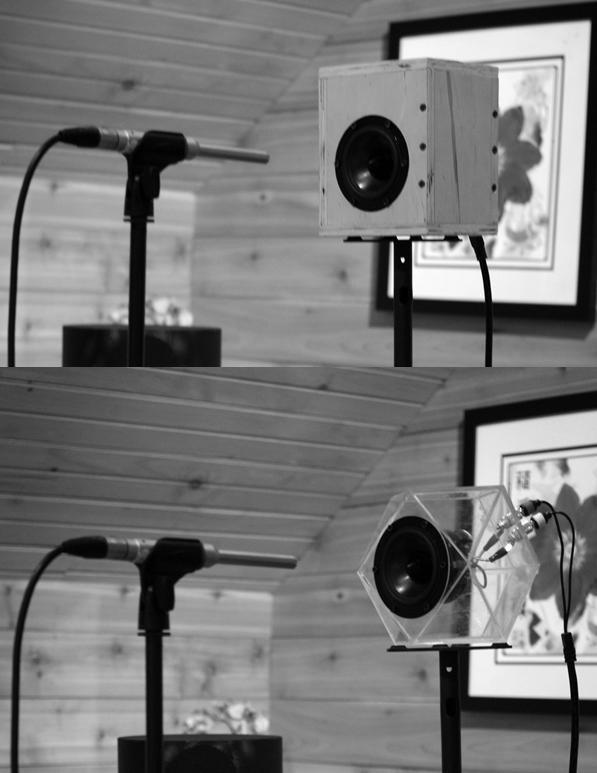
The improvements in loudspeaker acoustics achieved by using the IPT geometry seem like magic, but they are consequences of the shape’s unique symmetry, and a key to even more important applications of this geometry.

All acoustic musical devices depend upon resonance for the amplification of sound — except traditional loudspeakers. In traditional loudspeakers, the back-and-forth motion of the electrodynamic woofer tries to radiate sound in both directions, forwards and backwards. For a century this has been known to be a problem, because it loads energy into the environment the woofer has to continue operating in. To reduce the effect of the backward-pressure of the woofer, loudspeaker cabinets were stuffed with various damping materials like fiberglass to try to absorb the energy so that the woofer could escape the consequences of its actions.
Rather than throw all that energy away, however, a more effective solution might be to reshape the way air vibrates inside the cabinet so that it is not fighting against the woofer.
To do that, we need to reshape the cabinet. The ways in which air can vibrate are determined by its boundaries. The air in a long pipe is moving in all directions, all the time. But when we try to form sound waves in in it, it is easiest for the air to vibrate along the long axis of the pipe. Conversely, if we generate sound in air that is unenclosed, the energy spreads out in all available directions, producing a spherical wavefront.
In a traditional loudspeaker cabinet, the air wants to be motionless at the walls of the box, which is, unfortunately, where we usually put the woofer. A more effective approach would be to use a geometry that allows us to place the woofer in a place where the air wants to move already. To do that, we need to learn about the movement patterns called eigenfunctions, and how geometry influences them.
Consider a pipe closed at one end and open at the other. Sound waves travelling down the pipe will reflect from the closed end. Interestingly enough, sound waves approaching the open end will also reflect. some of their energy will escape, but the pressure oscillation at the open end will cause waves to travel back into the pipe.
Thus, both open and closed ends cause reflections. But there is a difference. The reflection from an open end causes a 180 degree phase inversion. When a low-pressure wavefront reaches the open end, it sucks air in from outside, generating a high-pressure wavefront that travels back into the pipe. Conversely, when a high-pressure wavefront reaches the open end, it escapes its limiting walls and spews out in all directions, generating a low-pressure wave travelling back into the pipe.